
Striking the angles of greatness: Inside the Museum of Islamic Art


My travels around the world have often led me to some of the most exciting and captivating attractions. Visiting museums is one of them.
Having been to London, Paris, Florence, Madrid and Barcelona – a running theme emerges as I’ve ticked off each city; a visit to one of its acclaimed museums. The National Gallery. The Louvre. The Uffizi. The Museo del Prado. Casa Batlló. And yes, call me old school, but I’ve likely kept the admittance ticket stub as a memento.
There’s something about museums isn’t there? Surrounded by sculptures, works of art that expand floor to ceiling of a wall, works from the greatest artists of all time, I find myself lost in a world where time stands still.
But it’s not only marvelling at the works of art in the museums I find fascinating. It’s how the spaces have been designed for flow, energy, integrating the visitor journey from one period of art movement to the next, the way that light is coaxed through a space, the lines that form, the lines that lead the eye – these are all the things I notice.
Doha’s Museum of Islamic Art (or The MIA as it’s affectionately known by the locals) is one I’ve found truly alluring. Located along the Corniche and surrounded by the waters of the Arabian Gulf, the striking geometric limestone structure of The MIA announces itself as a feature of its own, long before you step inside. Like a call to Mecca, it’s not hard to see why over 500,000 people visit the MIA every year.
Designed by IM Pei (the architectural genius behind The Louvre Pyramid), The MIA showcases Qatar’s world-class collections of Islamic art from the 7th to the 20th centuries.
IM Pei’s magnificence in capturing the essence of Islamic architecture is inspired by his travels to the Middle East, his research through mosques in Cordoba, Spain and Damascus, Syria and finally the ablution fountain at the Ibn Tulun Mosque in Cairo, Egypt.

“IM Pei often referenced sharp geometric forms, water, and the desert sun as imperative to the spirit of Islamic architecture.” – the MIA.
Stepping inside, and away from the stifling 40-plus degree heat, the MIA invites you to admire its breathtaking form – and it’s a mesmerising one that halts you in your tracks! Enough to notice the calm alabaster, gold and black palette.

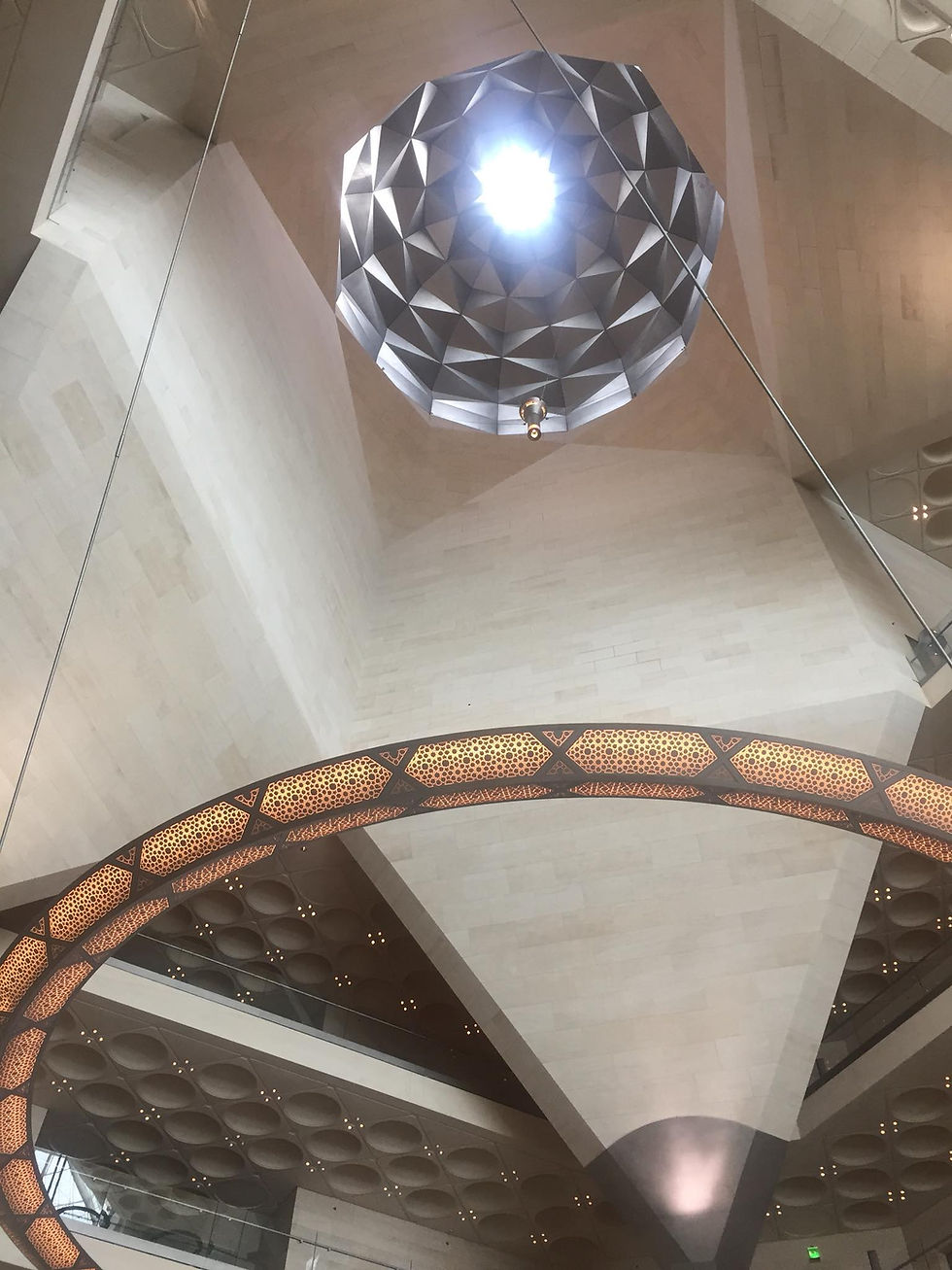
Nice, clean, geometric shapes adorn the floors – I’m ensconced by the 90-degree angles that gently caress the curved staircase. The oculus hovers nicely above, like a halo pulling the eyes upward to an even higher spectacle – the dome: the centrepiece that crowns the MIA.
Sunlight filters through the oculus and dances across the dome's geometric facets, shifting through the day as the light changes. Chandeliers amplify the effect, scattering warmth through what could otherwise feel like a cool, austere space. It's a lesson in how light can be used not just functionally, but emotionally.
Ascending the staircase, my curiosity grows – is there another geometric piece about to unveil? From the landing to mid to the top, I can’t help but snap about five different angles of the dome and oculus from my phone. Will I need them all? Probably not, but then again this one made my Insta page.
The visitor journey through the MIA's five levels and 18 galleries is equally considered. The galleries are organised by broad historical, cultural and geographic themes, but what strikes me as an interior design aficionado is how the spatial sequencing mirrors this. You're never disoriented. The flow from one period to the next feels intuitive, the transitions gentle. There's a quiet energy to it - the kind that draws you forward without you quite realising you're being led.
Traversing through each of the levels and its collections, I’m reminded why my love for art and interior design has never wavered. Each piece has its backstory, it summons the visitor to learn, to appreciate the cultural differences and intrinsic forms of Islamic art. From textiles, to ceramics, to manuscripts of the Qua’ran, to to war masks worn in the late 15th to early 16th centuries – my gaze gravitates from the historical to the dazzling emeralds from the Mughal period circa 19th century.
The day I visit, I’m humbled by a tribute exhibition to the late Muhammad Ali.
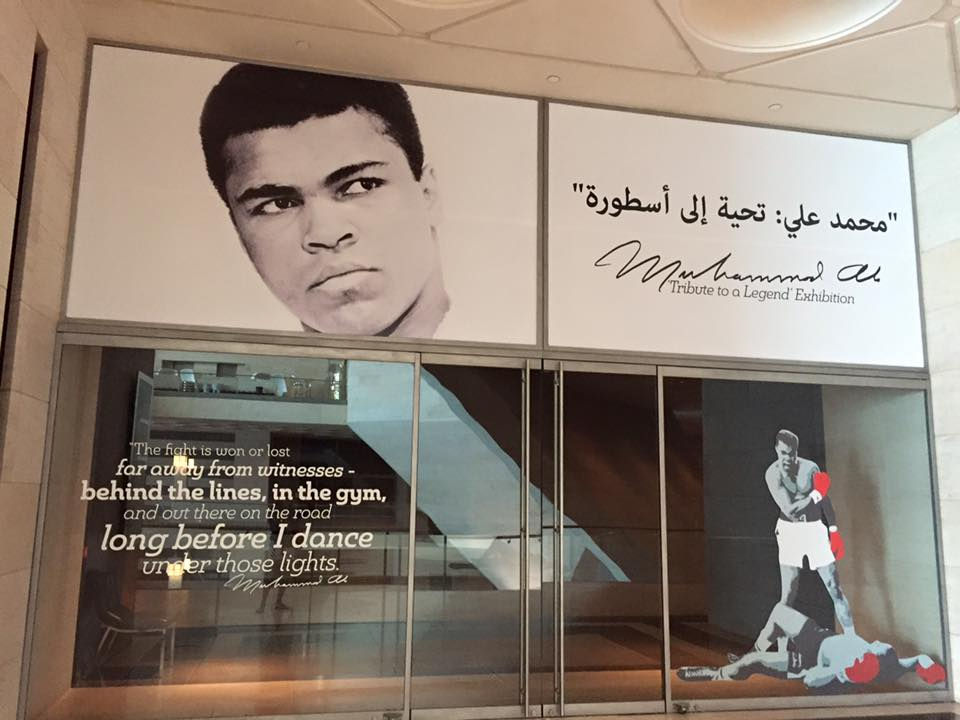
It's a lot to take in. Finishing the exhibit, I park myself on one of the ottomans and sit with the silence for a moment. There's something quietly powerful about encountering Ali’s legacy - his mindset as a boxer, his fight with Parkinson’s disease, his faith, his humanity - inside a building devoted to the very civilisation that shaped so much of who he was. I'm almost overcome.
I’m reminded of a quote by Ali to boost me up: “I am the greatest!” The MIA echoes this.

When I'm ready, I make my way to the MIA Café, located inside the Atrium where the massive glass curtain wall opens the room to the world outside. Over a coffee and lunch, the Doha city skyline stretches out across the Arabian Gulf - a reminder that this place doesn't exist in isolation. It's alive, anchored in a city that is itself a conversation between the ancient and the modern.
I glance at my gallery map to discover what else I haven’t seen.
The arches by the courtyard! Framing the skyline with that signature ablaq stonework, alternating bands of colour that echo the Mamluk tradition, the arches offer the perfect frame of Doha. I sit on the ledge, take it in and can’t help but ask a passerby to take a photo. The perfect Doha backdrop captured.
The MIA is unlike any museum I've visited. Not because of the scale, or the rarity of its collection, or even the genius of IM Pei's vision - though all of that is extraordinary. It's because it makes you feel something - the flow, a quiet energy, a stillness of time, a range of emotions. Great interior design anticipates how people will feel, not just where they will walk - the human experience inside it.
And isn't that exactly what great interior design is supposed to do?
Comments